Alcatraz wheelchair accessibility is real but partial, and I’d rather tell you that plainly than let a tour listing oversell it. The cellhouse itself is accessible, and a shuttle tram covers the steepest stretch of the climb from the dock, but parts of the outdoor grounds and some transition points stay genuinely uneven. Here’s what I’d actually do: plan around the tram’s schedule rather than assuming you can roll the whole route unassisted. I’d read this alongside the complete guide to planning your Alcatraz visit for the rest of the logistics around your trip.
Is Alcatraz actually wheelchair accessible?
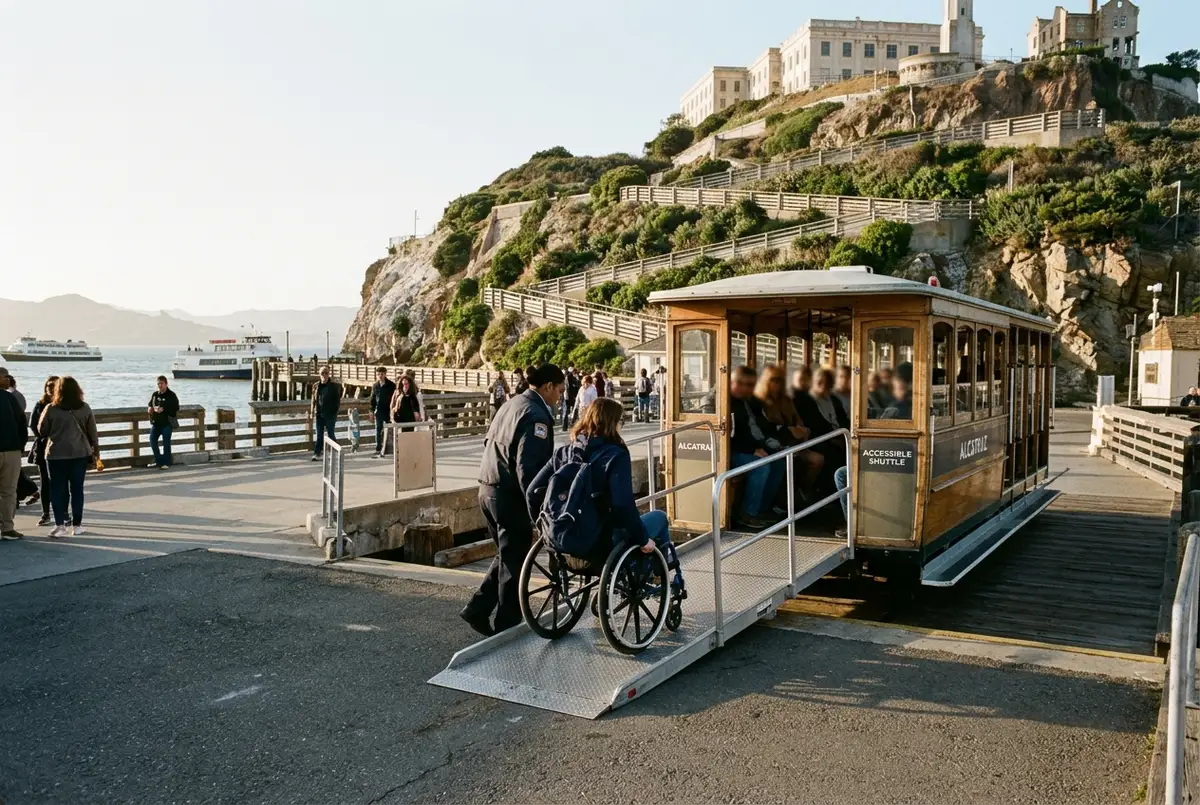
Mostly, yes, for the core experience. The cellhouse building, where the audio tour runs, is wheelchair accessible, and the National Park Service operates a shuttle tram that carries visitors who can’t manage the steep walk up from the dock.
I wouldn’t call the island fully accessible without caveats, though. The honest picture is a mix: the parts that matter most, the cellhouse and its exhibits, work well for wheelchair users, while a few outdoor sections and uneven surfaces genuinely limit how far you can go without assistance.
Check prices & dates
Ready to visit?
Book your tickets in advance: popular time slots sell out.
The tram covers the steepest grade between the dock and the top of the hill near the cellhouse, which is the single biggest physical barrier on the island, a quarter-mile climb that gains about 130 feet of elevation.
I’d treat the tram as the thing that makes this trip realistic for most visitors with mobility needs, not as a guarantee that covers every inch of the island. It solves the hardest part of the route. It doesn’t turn the whole island into flat, paved ground once you’re at the top.
What parts of Alcatraz are genuinely hard to access?
Some of the outdoor grounds, including sections of the Recreation Yard and parts of the historic gardens, sit on uneven or sloped terrain that a tram ride doesn’t fully resolve.
I’d rather flag this honestly than have you discover it on the island. The National Park Service itself is careful not to claim full accessibility everywhere, and I think that caution is accurate rather than overly cautious. If getting onto the island at all is still your bigger question, the full guide to getting to Alcatraz covers the ferry boarding process, which also has its own accessible boarding procedure worth knowing about ahead of time.
How accessible is the ferry crossing itself?
The ferry operated by Alcatraz City Cruises has accessible boarding and designated seating areas, and the crew assists with boarding for visitors who need it.
I’d call ahead or check in early at Pier 33 if you or someone in your group needs boarding assistance, rather than assuming the standard check-in line handles it automatically. A few extra minutes at the dock avoids a rushed boarding process once the boat is ready to leave.
Do you need to reserve the shuttle tram in advance?
I’d strongly recommend confirming tram availability before your visit rather than assuming it’ll be there and running when you arrive, since capacity and schedules can shift by season and sometimes by day.
This is the one planning step I wouldn’t skip. Contacting Alcatraz City Cruises or checking the current accessibility information directly before you book gives you a real answer specific to your travel dates, instead of a general assumption that might not hold on the day you actually go.
Is the audio tour itself accessible?
Yes. The Cellhouse Audio Tour runs on a handheld device you control entirely at your own pace, which works well for visitors who need extra time moving between stops or pausing along the way.
I think this is actually one of the island’s underrated accessibility strengths. Nobody’s rushing you through on a fixed guided schedule. You set the pace entirely, which matters a lot if mobility or stamina means you need more time at certain stops than the average visitor does.
What about accessible restrooms on the island?
Accessible restrooms are available near the dock and at points along the main visitor route, so this isn’t a major planning concern the way the hill itself can be.
I wouldn’t flag this as a real barrier based on what’s documented. It’s a reasonably well-covered part of the island’s accessibility setup, unlike the outdoor terrain, which is where I’d put most of your planning attention instead.
What should you expect inside the cellhouse itself once you’re there?
The main cellhouse floor is flat and navigable, with wide corridors between the cell blocks that handle a wheelchair comfortably, and the exhibits sit at a reasonable height along the main route.
I’d say this is genuinely the strongest part of the island’s accessibility setup. Once the tram and the initial climb are behind you, the building itself doesn’t throw up many more surprises. The harder planning problem is almost entirely about the outdoor terrain and the transition points, not the cellhouse experience you came for in the first place.
Should you bring your own mobility equipment or use what’s provided?
I’d bring your own wheelchair or mobility device if you have one you’re comfortable with, rather than relying solely on what the island might have on hand, since availability of loaner equipment can vary.
Your own equipment, fitted and familiar, handles uneven ground better than an unfamiliar loaner typically does. I’d treat the island’s own resources as a backup, not your primary plan, especially on a first visit when you don’t yet know how the terrain actually feels underfoot. The same logic applies to what everyone in your group wears that day. What to actually wear and bring on an Alcatraz tour covers footwear and layering, which matters just as much for mobility and comfort as the tram schedule does.
Is Alcatraz a good fit for visitors with limited stamina, not just wheelchair users?
Yes, with the same caveats. Limited stamina matters just as much as wheelchair access here, since even the tram-assisted route still involves some walking and standing through the cellhouse tour.
I’d pace the visit deliberately if stamina is the bigger concern rather than mobility specifically. Sit when benches are available, use the tram both ways if that’s an option for your ticket, and treat the two to three hours as a loose target rather than a schedule to rush through.
Is there a companion or caregiver policy worth knowing about?
A companion or caregiver traveling with a visitor who needs assistance generally rides the same ferry and tram without any special separate process beyond the normal ticket.
I wouldn’t expect a complicated system here. The practical advice I’d give is simpler: book your tickets together, check in together, and let the Pier 33 staff know ahead of boarding if anyone in your group needs tram access or boarding assistance, so it’s arranged before you’re standing at the gate.
Does bringing kids change the accessibility picture?
A little. If you’re traveling with both a mobility need and young kids, I’d plan extra time for the tram and the walk, since you’re managing two different paces at once rather than just your own.
My actual recommendation on Alcatraz accessibility
Go, but plan around the tram rather than assuming the whole island rolls as easily as the cellhouse does. Confirm availability ahead of your date, bring your own equipment if you have it, and build in extra time rather than rushing the route.
Is Alcatraz wheelchair accessible?
Partially. The cellhouse is accessible and a shuttle tram covers the steepest climb, but some outdoor areas and transitions remain genuinely uneven.
Does the Alcatraz ferry have accessible boarding?
Yes, Alcatraz City Cruises offers accessible boarding and seating, and I’d check in early if you need assistance rather than relying on the standard line.
Do I need to book the shuttle tram in advance?
I’d confirm availability directly before your trip rather than assume it, since tram schedules and capacity can shift by season.
Is the Cellhouse Audio Tour accessible for slower-paced visitors?
Yes. It’s entirely self-paced on a handheld device, so you control how long you spend at each stop without a guide setting the schedule.
Are there accessible restrooms on Alcatraz Island?
Yes, near the dock and along the main visitor route, which makes this a smaller planning concern than the outdoor terrain itself.
Can a caregiver or companion ride along without a separate process?
Generally yes. Book tickets together and let Pier 33 staff know ahead of boarding if anyone needs tram access, so it’s arranged before you reach the gate.